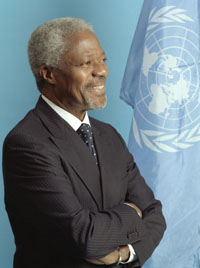
 Kofi Annan
of Ghana is the seventh Secretary-General of the United
Nations. The first Secretary-General to be elected from the ranks of
United Nations staff, he began his first term on 1 January 1997. On
29 June 2001, acting on a recommendation by the Security Council,
the General Assembly appointed him by acclamation to a second term
of office, beginning on 1 January 2002 and ending on 31 December
2006. Kofi Annan
of Ghana is the seventh Secretary-General of the United
Nations. The first Secretary-General to be elected from the ranks of
United Nations staff, he began his first term on 1 January 1997. On
29 June 2001, acting on a recommendation by the Security Council,
the General Assembly appointed him by acclamation to a second term
of office, beginning on 1 January 2002 and ending on 31 December
2006.
Mr. Annan's priorities as Secretary-General have been to
revitalize the United Nations through a comprehensive programme of
reform; to strengthen the Organization's traditional work in the
areas of development and the maintenance of international peace and
security; to encourage and advocate human rights, the rule of law
and the universal values of equality, tolerance and human dignity
found in the United Nations Charter; and to restore public
confidence in the Organization by reaching out to new partners and,
in his words, by "bringing the United Nations closer to the
people".
Mr. Annan was born in Kumasi, Ghana, on 8 April
1938. He studied at the University of Science and Technology in
Kumasi and completed his undergraduate work in economics at
Macalester College in St. Paul, Minnesota, U.S.A., in 1961. From
1961 to 1962, he undertook graduate studies in economics at the
Institut universitaire des hautes études internationales in Geneva.
As a 1971-1972 Sloan Fellow at the Massachusetts Institute of
Technology, Mr. Annan received a Master of Science degree in
management.
Mr. Annan joined the United Nations system in
1962 as an administrative and budget officer with the World Health
Organization (WHO) in Geneva. Since then, he has served with the UN
Economic Commission for Africa (ECA) in Addis Ababa; the United
Nations Emergency Force (UNEF II) in Ismailia; the Office of the
United Nations High Commissioner for Refugees (UNHCR) in Geneva;
and, at UN Headquarters in New York, as Assistant Secretary-General
for Human Resources Management and Security Coordinator for the UN
System (1987-1990) and Assistant Secretary-General for Programme
Planning, Budget and Finance, and Controller (1990-1992).
In
1990, following the invasion of Kuwait by Iraq, Mr. Annan was asked
by the Secretary-General, as a special assignment, to facilitate the
repatriation of more than 900 international staff and citizens of
Western countries from Iraq. He subsequently led the first United
Nations team negotiating with Iraq on the sale of oil to fund
purchases of humanitarian aid.
Before being appointed
Secretary-General, Mr. Annan served as Assistant Secretary-General
for Peacekeeping Operations (March 1992-February 1993) and then as
Under-Secretary-General (March 1993-December 1996). His tenure
as
Under-Secretary-General coincided with unprecedented growth in
the size and scope of United Nations peacekeeping operations, with a
total deployment, at its peak in 1995, of almost 70,000 military and
civilian personnel from 77 countries. From November 1995 to March
1996, following the Dayton Peace Agreement that ended the war in
Bosnia and Herzegovina, Mr. Annan served as Special Representative
of the Secretary-General to the former Yugoslavia, overseeing
the
transition in Bosnia and Herzegovina from the United Nations
Protection Force (UNPROFOR) to the multinational Implementation
Force (IFOR) led by the North Atlantic Treaty Organization
(NATO).
As Secretary-General, Mr. Annan's first major
initiative was his plan for reform, "Renewing the United Nations",
which was presented to the Member States in July 1997 and has been
pursued ever since with an emphasis on improving
coherence and
coordination. His April 1998 report to the Security Council on "The
Causes of Conflict and the Promotion of Durable Peace and
Sustainable Development in Africa" was among several efforts to
maintain the international community's commitment to Africa, the
most disadvantaged of the world's regions.
He has used his
good offices in several delicate political situations. These
included an attempt in 1998 to gain Iraq's compliance with Security
Council resolutions; a mission in 1998 to help promote the
transition to civilian rule in
Nigeria; an agreement in 1999 to
resolve a stalemate between Libya and the Security Council over the
1988 Lockerbie bombing; diplomacy in 1999 to forge an international
response to violence in East Timor; the certification of
Israel's
withdrawal from Lebanon in September 2000, and further
efforts, since the renewed outbreak of violence in September 2000,
to encourage Israelis and Palestinians to resolve their differences
through peaceful negotiations based on Security Council resolutions
242 and 338 and the principle of "land for peace".
Mr. Annan has also sought to improve the status of women in
the Secretariat and to build closer partnerships with civil society,
the private sector and other non-State actors whose strengths
complement those of the United Nations; in
particular, he has
called for a "Global Compact" involving leaders of the world
business community as well as labour and civil society
organizations, aimed at enabling all the world's people to share the
benefits of globalization and embedding the global market in values
and practices that are fundamental to meeting socio-economic
needs.
In April 2000, he issued a Millennium Report, entitled
"We the Peoples: The Role of the United Nations in the 21st
Century", calling on Member States to commit themselves to an action
plan for ending poverty and inequality, improving
education,
reducing HIV/AIDS, safeguarding the environment and protecting
peoples from deadly conflict and violence. The Report formed the
basis of the Millennium Declaration adopted by Heads of State and
Government at the Millennium Summit, held at UN Headquarters in
September 2000..
In April 2001, the Secretary-General issued
a five-point "Call to Action" to address the HIV/AIDS epidemic --
which he described as his "personal priority" -- and proposed the
establishment of a Global AIDS and Health Fund to serve as
a
mechanism for some of the increased spending needed to help
developing countries confront the crisis.
On 10 December
2001, the Secretary-General and the United Nations received the
Nobel Peace Prize. In conferring the Prize, the Nobel Committee said
Mr. Annan “had been pre-eminent in bringing new life to the
Organization”. In also conferring the Prize on the world body, the
Committee said that it wished “to proclaim that the only negotiable
road to global peace and cooperation goes by way of the United
Nations”.
The Secretary-General is fluent in English, French
and several African languages. He is married to Nane Annan, of
Sweden, a lawyer and artist who has a great interest in
understanding the work of the United Nations in the field. Two
issues of particular concern to her are HIV/AIDS and education for
women. She has also written a book for children about the United
Nations. Mr. and Mrs. Annan have three children.
Maintained by the Department
of Public Information
© United Nations,
2000-2002 |







 Kofi Annan
of Ghana is the seventh Secretary-General of the United
Nations. The first Secretary-General to be elected from the ranks of
United Nations staff, he began his first term on 1 January 1997. On
29 June 2001, acting on a recommendation by the Security Council,
the General Assembly appointed him by acclamation to a second term
of office, beginning on 1 January 2002 and ending on 31 December
2006.
Kofi Annan
of Ghana is the seventh Secretary-General of the United
Nations. The first Secretary-General to be elected from the ranks of
United Nations staff, he began his first term on 1 January 1997. On
29 June 2001, acting on a recommendation by the Security Council,
the General Assembly appointed him by acclamation to a second term
of office, beginning on 1 January 2002 and ending on 31 December
2006.